Remove the Leaky Abstractions

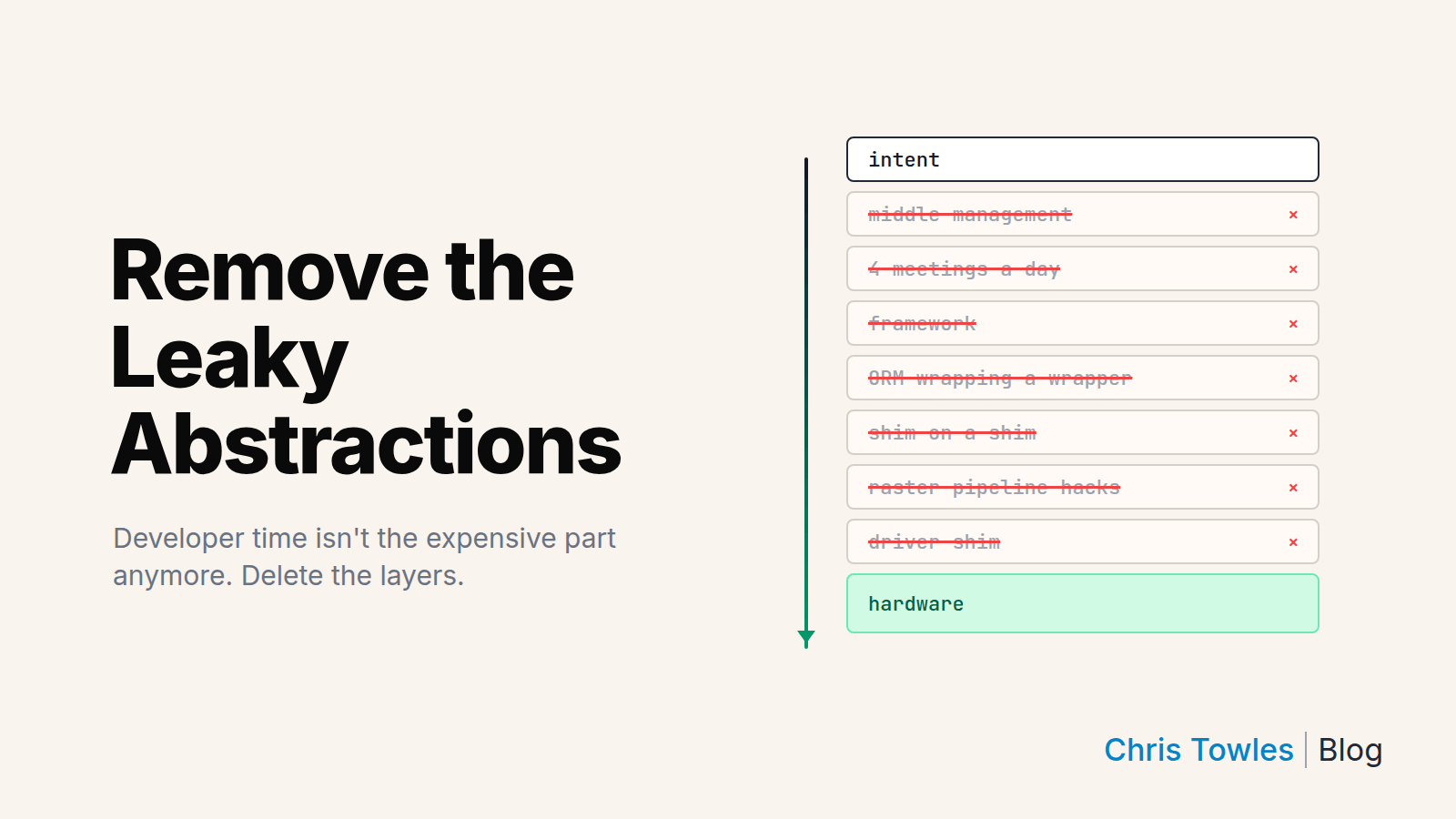
Boris Tane said the software development lifecycle is dead. I don't know where this is going. But with the models getting more capable every few months, the whole stack starts to look like a liability. Every layer we added to save developer time was a tax on the machine, and developer time isn't the expensive part anymore.
I'm not a Rust developer. My first Rust commit was May 12 of this year. Didn't matter, the model can write it. So now I'm trying to figure out what sits between my app and the pixel, and which of those layers add value and which ones I can just remove.
The best example I've got isn't mine. zero is my brother Patrick's repo, and I only started helping with it last week. Instead of stacking more workarounds on the raster pipeline, he skipped it and went straight to a pure-Vulkan path tracer in Rust, ReSTIR for the lights and DLSS Ray Reconstruction to clean up the frame. You don't get there by tuning the old layers.
There's a game on top of it too, but that's his to show. 740 commits in, the moon casts real shadows and you can look through a door into a level four and a half kilometers away.
A pixel is still just electrons, though. The part I keep coming back to is the next step: going from the hardware to actually moving atoms. Robots, printers, machines that build things. I'd bet the same rule holds there, the fewer layers between what you want and the motor that does it, the better. I haven't figured that part out yet.
Same goes for the org. Management layers are leaky abstractions too. Four meetings a day that should have been an email is the org version of a shim on a shim. Those layers were there to coordinate hundreds of people writing code by hand, and now a small group can prompt out what many companies shipped over their whole lifetimes. There's not much left for them to do.
Strip it down to what the hardware, and the people, actually need. Small teams go fast, always did.